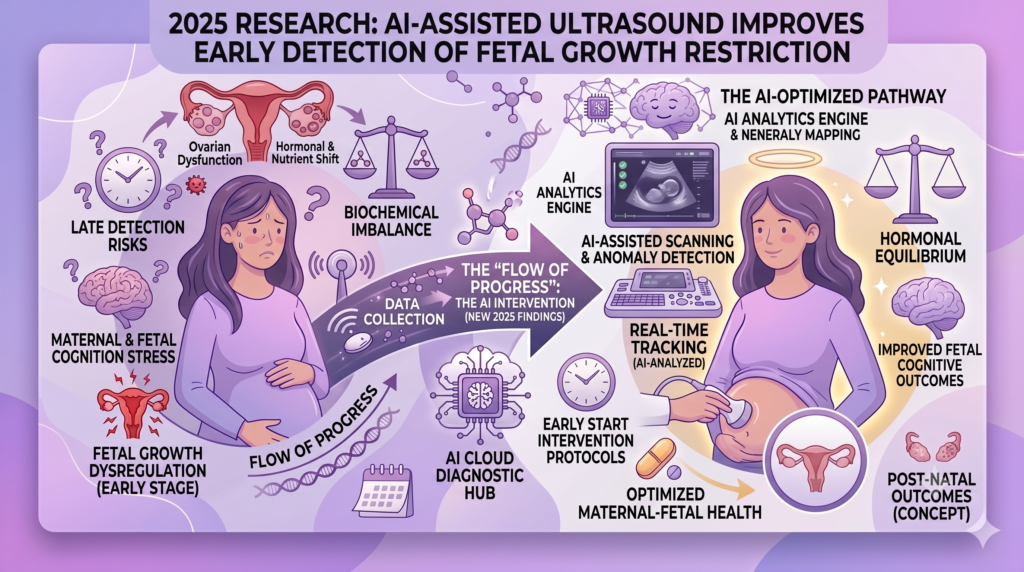
2025 Research: AI-Assisted Ultrasound Improves Early Detection of Fetal Growth Restriction
A 2025 multi-centre validation study has demonstrated that AI-assisted ultrasound analysis significantly improves the early detection of fetal growth restriction compared to standard manual biometry assessment alone, identifying at-risk pregnancies an average of 1.5 to 2 weeks earlier — a window that can meaningfully change clinical management and outcomes. As Dubai continues to position itself as a regional hub for advanced medical technology adoption, developments like this AI-assisted ultrasound research are of particular interest to the city’s growing network of specialist obstetric and fetal medicine providers, who frequently look to integrate validated new technologies ahead of broader regional uptake. What Fetal Growth Restriction Is and Why Early Detection Matters Fetal growth restriction occurs when a baby does not grow at the expected rate in the womb, most commonly due to placental insufficiency. Early detection allows for closer monitoring, optimised timing of delivery, and in some cases, interventions that can improve outcomes — but growth restriction can be subtle and easily missed using standard measurement techniques, particularly in its earlier stages. How AI-Assisted Ultrasound Works The technology evaluated in this research uses machine learning algorithms trained on large datasets of fetal ultrasound images to detect subtle growth trajectory deviations and structural patterns associated with placental insufficiency, flagging cases for closer review that might fall within a ‘borderline normal’ range on standard manual assessment. Relevance for High-Risk Pregnancy Care in Dubai Dubai’s specialist obstetric centres, including those in Dubai Healthcare City, increasingly incorporate advanced ultrasound technology into routine and high-risk antenatal care. For women identified as having risk factors for growth restriction — including hypertension, smoking history, previous growth-restricted pregnancy, or multiple pregnancy — access to the most sensitive available screening technology can provide valuable additional reassurance or earlier warning. What This Means for Your Antenatal Scans This research does not replace the fundamental importance of regular antenatal monitoring, symphysis-fundal height measurement, and clinical assessment by an experienced obstetrician. Rather, it represents a valuable complementary tool that, where available, can enhance the accuracy of an already comprehensive growth surveillance programme for at-risk pregnancies. A Note on Algorithm Diversity As with many AI-assisted diagnostic tools entering clinical practice, an important ongoing question is how these algorithms perform across genuinely diverse patient populations, including the wide range of ethnic backgrounds represented in Dubai’s pregnant population. Researchers and clinicians implementing this technology are increasingly attentive to ensuring training datasets reflect this diversity, since algorithms trained predominantly on one population can sometimes perform less reliably in others — a consideration worth raising with your obstetrician if this technology is offered as part of your care. How This Compares to Current Standard Practice in Dubai Several of Dubai’s leading fetal medicine and obstetric ultrasound centres have already begun incorporating advanced ultrasound technology into routine practice, positioning the city’s specialist obstetric care among the more technologically current internationally. Frequently Asked Questions Is AI-assisted ultrasound available for pregnancy monitoring in Dubai? Advanced ultrasound technology is increasingly available across leading UAE obstetric centres. Ask your obstetrician whether this technology is incorporated into your specific growth surveillance plan if you have risk factors for fetal growth restriction. Does AI replace the need for a specialist sonographer or obstetrician? No. AI-assisted analysis is a decision-support tool used alongside, not instead of, expert clinical interpretation by trained sonographers and obstetricians. Will AI-assisted ultrasound replace my regular growth scans? No. It is intended to enhance, not replace, the established schedule of growth scans and clinical assessment already recommended for pregnancies with risk factors for growth restriction. Conclusion Advances in ultrasound technology continue to improve how high-risk pregnancies are monitored and managed. Women in Dubai with risk factors for growth restriction should discuss the most current monitoring options available with their specialist obstetrician. Sources & References This article references recently published research and evolving guidance from peer-reviewed journals and the following recognised authorities in women’s health, current as of the time of writing: Royal College of Obstetricians and Gynaecologists (RCOG) — rcog.org.uk American College of Obstetricians and Gynecologists (ACOG) — acog.org International Federation of Gynecology and Obstetrics (FIGO) — figo.org World Health Organization (WHO) — who.int National Institute for Health and Care Excellence (NICE, UK) — nice.org.uk American Society for Reproductive Medicine (ASRM) — asrm.org European Society of Human Reproduction and Embryology (ESHRE) — eshre.eu ⚠ IMPORTANT DISCLAIMER This article is provided for general knowledge and reference purposes only and summarises recent research findings. It is not a substitute for professional medical advice, diagnosis, or treatment. No medication, treatment, or change to your healthcare should be undertaken based on this content without first consulting a qualified doctor. Always seek the advice of your physician or another qualified health provider with any questions you may have regarding a medical condition. Consult Dr. Ruby Rashmi Specialist Obstetrician & Gynecologist, Dubai. Benefit from evidence-based pregnancy care, advanced fetal monitoring, and personalised management for high-risk pregnancies. Contact Us