A 2025 regional study examining vitamin D status among women with PCOS across the Gulf states has found a striking and clinically significant correlation: women with more severe vitamin D deficiency showed worse PCOS metabolic and reproductive markers, including greater insulin resistance and more irregular cycles, even after controlling for BMI. This finding adds an important layer of nuance to how PCOS is understood and managed specifically within Gulf-region healthcare settings, where the population’s unique combination of genetic background, lifestyle patterns, and environmental sun-exposure behaviour creates a distinct clinical picture that does not always mirror PCOS research conducted in other parts of the world.
Why Vitamin D Deficiency Is Common in the Gulf Region
Despite abundant year-round sunshine, vitamin D deficiency is paradoxically common across Gulf populations, driven by limited direct sun exposure due to clothing norms, predominantly indoor lifestyles in air-conditioned environments, and high use of sun protection. This makes the Gulf region one of the more unexpected hotspots for vitamin D deficiency globally.
What the New Research Found
The 2025 study found that women with PCOS and severe vitamin D deficiency (levels below 12.5 nmol/L) showed measurably higher fasting insulin and HOMA-IR scores — markers of insulin resistance — than PCOS patients with adequate vitamin D status, alongside higher rates of menstrual irregularity. The data supports a growing hypothesis that vitamin D plays a direct role in ovarian function and insulin signalling, beyond its established role in bone health.
What This Means for Women in Dubai
For women across Dubai managing PCOS — including those in Al Fahidi, Business Bay, and Dubai Healthcare City — this research reinforces the value of routine vitamin D testing as part of a comprehensive PCOS evaluation, not simply as a general wellness check. Correcting significant deficiency may represent a low-cost, low-risk component of a broader PCOS management plan, alongside established treatments.
What to Do With This Information
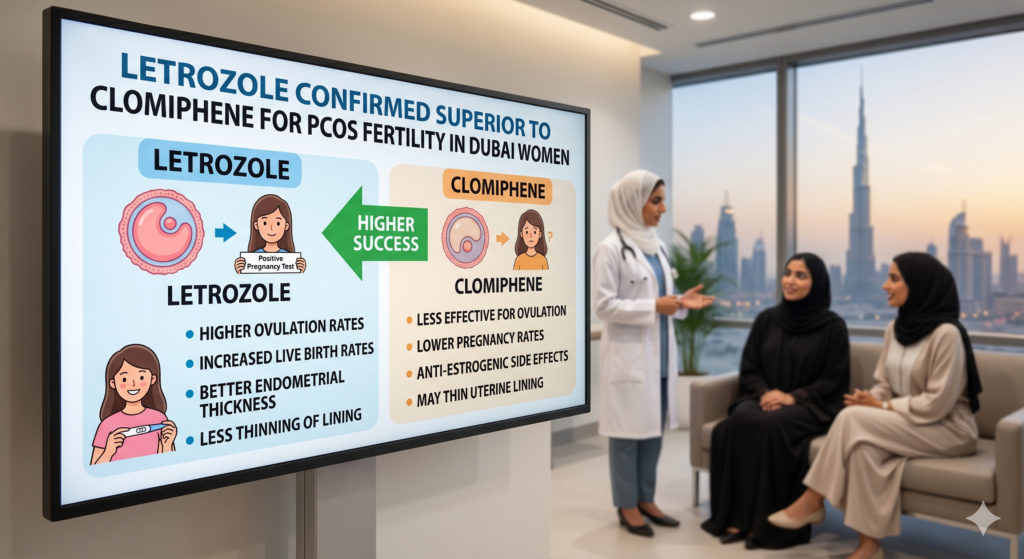
This research does not suggest vitamin D supplementation alone can treat PCOS, and it should not replace evidence-based first-line treatments such as lifestyle modification, metformin, or letrozole for fertility. Rather, it supports vitamin D assessment and correction as a complementary, evidence-supported addition to standard PCOS care for women found to be deficient.
A Broader Question for Gulf-Region Women’s Health
This research also raises an interesting broader question for Gulf-region women’s health more generally: how many other common conditions might be subtly influenced by the region’s distinctive pattern of vitamin D deficiency despite abundant sunshine? Conditions including mood disorders, autoimmune disease activity, and even certain pregnancy complications have all shown associations with vitamin D status in various studies, suggesting that routine vitamin D assessment may have value extending well beyond PCOS care alone for women living in this region.
How This Compares to Current Standard Practice in Dubai
Vitamin D testing is already a relatively common component of comprehensive health assessments in Dubai, given general regional awareness of deficiency prevalence. This research provides additional, specific justification for including it within PCOS-focused evaluations rather than general wellness checks alone.
Frequently Asked Questions
Should every woman with PCOS get her vitamin D tested?
Can vitamin D supplements cure PCOS?
What vitamin D level is considered deficient?
Conclusion
This regionally specific research highlights why PCOS care in Dubai should account for the particular health context of the Gulf population. Dr. Ruby Rashmi incorporates vitamin D and broader metabolic assessment into every comprehensive PCOS evaluation.
Sources & References
This article references recently published research and evolving guidance from peer-reviewed journals and the following recognised authorities in women’s health, current as of the time of writing:
- Royal College of Obstetricians and Gynaecologists (RCOG) — rcog.org.uk
- American College of Obstetricians and Gynecologists (ACOG) — acog.org
- International Federation of Gynecology and Obstetrics (FIGO) — figo.org
- World Health Organization (WHO) — who.int
- National Institute for Health and Care Excellence (NICE, UK) — nice.org.uk
- American Society for Reproductive Medicine (ASRM) — asrm.org
- European Society of Human Reproduction and Embryology (ESHRE) — eshre.eu
⚠ IMPORTANT DISCLAIMER
This article is provided for general knowledge and reference purposes only and summarises recent research findings. It is not a substitute for professional medical advice, diagnosis, or treatment.
No medication, treatment, or change to your healthcare should be undertaken based on this content without first consulting a qualified doctor. Always seek the advice of your physician or another qualified health provider with any questions you may have regarding a medical condition.
Consult Dr. Ruby Rashmi
Specialist Obstetrician & Gynecologist, Dubai. Receive comprehensive PCOS evaluation with personalised metabolic assessment, vitamin D screening, fertility guidance, and evidence-based treatment plans.