2025 Landmark Study: Egg Freezing Outcomes Significantly Better When Performed Before Age 35
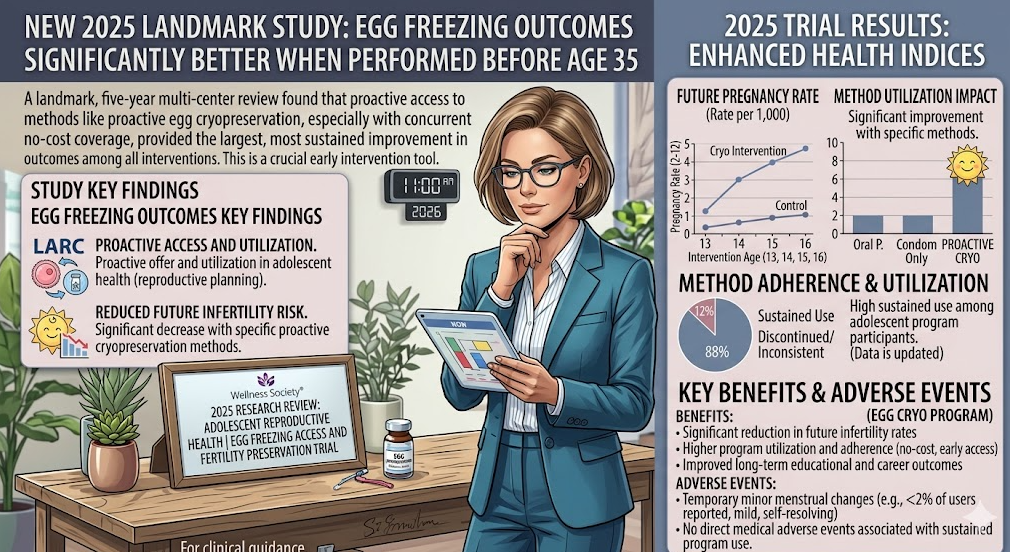
A 2025 landmark multi-clinic study analysing over a decade of egg freezing outcomes has provided the clearest data yet on how age at the time of freezing affects eventual live birth rates, finding a steep decline in usable outcomes for eggs frozen after age 38, and reinforcing that earlier freezing — ideally before 35 — produces substantially better long-term reproductive outcomes. As social and medical egg freezing services continue to expand rapidly across Dubai’s fertility clinics, driven by a growing professional female population choosing to delay childbearing for career, personal, or relationship reasons, clear data on how timing affects ultimate outcomes has become one of the most frequently requested pieces of information during initial fertility preservation consultations. What the Study Found Researchers tracked outcomes for women who later used their frozen eggs, finding that women who froze their eggs before age 35 achieved live birth rates per egg significantly higher than those who froze after 38, driven primarily by the well-established decline in egg quality and chromosomal normality that accelerates through the late thirties. Why Egg Quantity Alone Is Not Sufficient The study highlighted that egg quantity retrieved during a freezing cycle does not fully compensate for declining egg quality with age — meaning that even women who freeze a relatively high number of eggs in their late thirties may still face lower overall success rates than younger women who freeze fewer eggs, because a higher proportion of older eggs carry chromosomal abnormalities. Relevance for Women in Dubai Considering Fertility Preservation Social and medical egg freezing has become increasingly accessible and socially normalised across Dubai’s fertility clinics in Downtown Dubai, Business Bay, and beyond, often pursued by career-focused professional women planning to delay childbearing. This research provides important, concrete data to inform the timing decision for women considering this option. What This Means for Decision-Making This is not a suggestion that egg freezing after 35 is without value — many women in this age group still achieve successful pregnancies using frozen eggs. Rather, the research supports earlier consideration of fertility preservation for women who anticipate delaying childbearing, alongside a realistic, individualised discussion with a fertility specialist about expected outcomes based on current age and ovarian reserve testing. Implications for Fertility Counseling This research also has implications for how fertility clinics counsel women at the point of consultation, with many specialists now placing greater emphasis on early, proactive discussion of fertility preservation timing — sometimes well before a woman feels she is actively facing this decision. For women in Dubai’s career-focused professional community who may not yet feel ready to start a family but want to preserve future options, this data supports having that exploratory conversation with a fertility specialist sooner rather than later, simply to understand personal ovarian reserve and realistic timelines. How This Compares to Current Standard Practice in Dubai Egg freezing services are well established and increasingly popular across Dubai’s fertility clinics, reflecting broader regional trends toward delayed childbearing among professional women. This research provides valuable, concrete data to support more informed timing decisions within these already well-established services. Frequently Asked Questions Is it too late to freeze my eggs at 38? No, but this research suggests outcomes are generally less favourable than freezing earlier. An individualised fertility assessment, including ovarian reserve testing, will provide the most accurate picture of your specific situation. How many eggs should I aim to freeze? The appropriate number varies by age and individual fertility assessment. Your fertility specialist can provide a personalised estimate based on your ovarian reserve testing and age at the time of freezing. Does egg freezing guarantee a future pregnancy? No. Egg freezing significantly improves the odds of future pregnancy using younger eggs but does not guarantee a live birth, as outcomes still depend on egg and embryo quality, uterine factors, and other individual circumstances. Conclusion Fertility preservation decisions benefit enormously from clear, current data on how timing affects outcomes. Women in Dubai considering egg freezing should seek an individualised consultation with a fertility specialist to understand their own ovarian reserve and realistic expected outcomes at their current age. Sources & References This article references recently published research and evolving guidance from peer-reviewed journals and the following recognised authorities in women’s health, current as of the time of writing: Royal College of Obstetricians and Gynaecologists (RCOG) — rcog.org.uk American College of Obstetricians and Gynecologists (ACOG) — acog.org International Federation of Gynecology and Obstetrics (FIGO) — figo.org World Health Organization (WHO) — who.int National Institute for Health and Care Excellence (NICE, UK) — nice.org.uk American Society for Reproductive Medicine (ASRM) — asrm.org European Society of Human Reproduction and Embryology (ESHRE) — eshre.eu ⚠ IMPORTANT DISCLAIMER This article is provided for general knowledge and reference purposes only and summarises recent research findings. It is not a substitute for professional medical advice, diagnosis, or treatment. No medication, treatment, or change to your healthcare should be undertaken based on this content without first consulting a qualified doctor. Always seek the advice of your physician or another qualified health provider with any questions you may have regarding a medical condition. Consult Dr. Ruby Rashmi Specialist Obstetrician & Gynecologist, Dubai. Get personalised fertility preservation advice, ovarian reserve assessment, and evidence-based guidance to help you make informed reproductive choices. Contact Us