
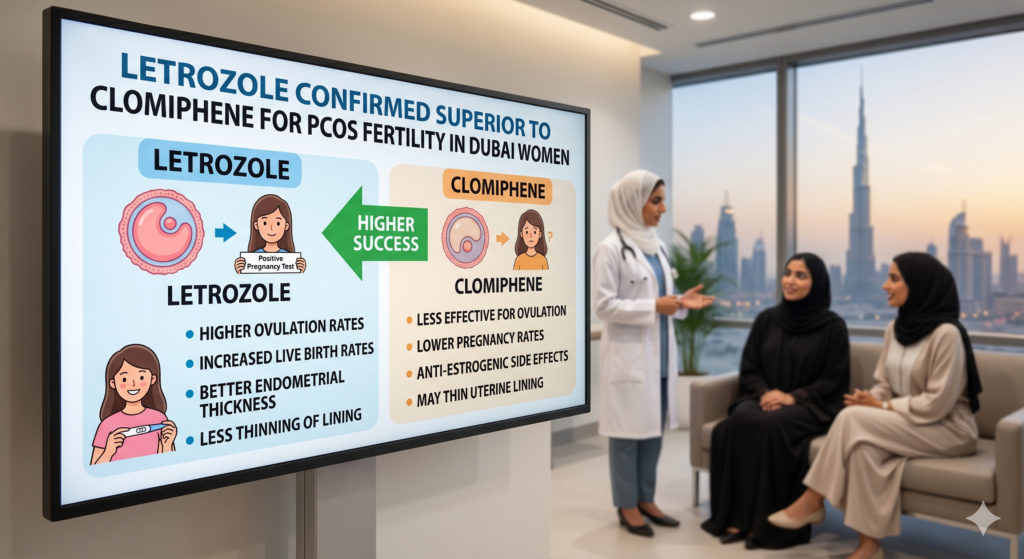
New 2025 Research: Letrozole Confirmed Superior to Clomiphene for PCOS Fertility in Dubai Women
1. New 2025 Research: Letrozole Confirmed Superior to Clomiphene for PCOS Fertility in Dubai Women A major 2025 meta-analysis pooling data from over 15 randomised controlled trials has reaffirmed what reproductive specialists have suspected for nearly a decade: letrozole, not clomiphene citrate, should be the first-line ovulation induction agent for women with PCOS-related infertility. For the growing number of women across Dubai navigating a PCOS diagnosis while trying to conceive, this update matters — it changes what the most effective first step toward pregnancy actually looks like. This finding arrives at a particularly relevant moment for Dubai’s fertility landscape. The city’s clinics, serving one of the world’s most internationally diverse patient populations, see an especially high volume of PCOS-related fertility consultations each year, making access to the most current, internationally validated treatment protocols a genuine priority rather than an academic curiosity for the women searching for the best gynecologist or fertility specialist across neighbourhoods from Mankhool to Business Bay. What the New Research Shows The updated analysis, synthesising data following on from the landmark NEJM PPCOS II trial, confirms that letrozole produces significantly higher live birth rates per cycle than clomiphene citrate — approximately 27.5% versus 19.1% — without increasing the risk of multiple pregnancy. Researchers also found that letrozole’s anti-oestrogenic profile avoids the endometrial thinning historically associated with clomiphene, which may partly explain its superior implantation outcomes. Why This Matters for Women in Dubai PCOS prevalence in the Gulf region is estimated at the higher end of global ranges, partly due to elevated background rates of insulin resistance in South Asian, Arab, and broader regional populations. Many women across Dubai — from Mankhool and Bur Dubai to Business Bay and Jumeirah — are diagnosed with PCOS in their twenties and thirties, often during a fertility work-up. Access to first-line, evidence-based treatment from the outset avoids unnecessary delay, a particularly important consideration for women trying to conceive in their mid-to-late thirties. What This Means in Practice For women beginning ovulation induction, this research supports a clear treatment sequence: letrozole first, with metformin considered as an adjunct in women with confirmed insulin resistance, and gonadotropins or laparoscopic ovarian drilling reserved for those who do not respond after several cycles. It also reinforces that lifestyle modification — even a 5–10% reduction in body weight for women who are overweight — remains a powerful first step that can restore ovulation in over half of cases before medication is even required. Finding the Right Specialist Women searching for the best gynecologist in Dubai for PCOS and fertility should look for a specialist who stays current with evolving international guidance — RCOG, ASRM, and ESHRE all updated their PCOS fertility recommendations within the past two years. Dr. Ruby Rashmi integrates this updated evidence into every PCOS consultation, ensuring patients across Dubai Healthcare City, Al Seef, and surrounding communities receive treatment aligned with the most current research, not outdated protocols. Putting This Research Into Context It is worth understanding why this shift in evidence took so long to translate into guideline changes. Clomiphene citrate was the default ovulation induction agent for nearly 50 years, and changing entrenched first-line practice across thousands of clinics worldwide requires not just one trial but a consistent, replicated body of evidence — which is exactly what has accumulated since the original PPCOS II results. For women in Dubai weighing their own fertility treatment plan, this history is a useful reminder that asking your specialist which medication aligns with the most current evidence, rather than simply the most familiar one, is always a reasonable and important question. How This Compares to Current Standard Practice in Dubai Most reproductive endocrinology and fertility clinics across Dubai have already begun incorporating letrozole as a first-line option in line with international shifts in practice over recent years. This 2025 meta-analysis strengthens the confidence with which specialists can recommend it, and patients should feel comfortable discussing the evidence base behind their specific treatment plan during their consultation. Frequently Asked Questions Is letrozole safe to use for PCOS fertility treatment? Yes. Letrozole has an extensive safety record in ovulation induction and is now the preferred first-line agent in most international guidelines, including ESHRE and ASRM updates. Where can I find a gynecologist in Dubai who treats PCOS-related infertility? Dr. Ruby Rashmi provides comprehensive PCOS and fertility evaluation from her Dubai practice, conveniently accessible to women across Mankhool, Bur Dubai, Downtown Dubai, and Business Bay. Will my Dubai gynecologist automatically prescribe letrozole over clomiphene? Most specialists who stay current with international guidelines now favour letrozole as first-line. If you are prescribed clomiphene first, it is reasonable to ask your specialist about their reasoning relative to this updated evidence. Conclusion This research reinforces a simple but important message: PCOS-related infertility is highly treatable, and the evidence on the most effective first step has never been clearer. Women in Dubai considering fertility treatment for PCOS deserve a specialist who applies this updated evidence from the very first consultation. Sources & References This article references recently published research and evolving guidance from peer-reviewed journals and the following recognised authorities in women’s health, current as of the time of writing: Royal College of Obstetricians and Gynaecologists (RCOG) — rcog.org.uk American College of Obstetricians and Gynecologists (ACOG) — acog.org International Federation of Gynecology and Obstetrics (FIGO) — figo.org World Health Organization (WHO) — who.int National Institute for Health and Care Excellence (NICE, UK) — nice.org.uk American Society for Reproductive Medicine (ASRM) — asrm.org European Society of Human Reproduction and Embryology (ESHRE) — eshre.eu ⚠ IMPORTANT DISCLAIMER This article is provided for general knowledge and reference purposes only and summarises recent research findings. It is not a substitute for professional medical advice, diagnosis, or treatment. No medication, treatment, or change to your healthcare should be undertaken based on this content without first consulting a qualified doctor. Always seek the advice of your physician or another qualified health provider with any questions you may have regarding a medical condition. Consult Dr. Ruby Rashmi Specialist Obstetrician